
Our work with Haringey Learning Partnership
With thanks to Barings Foundation
Words by Teju Adeleye, Producer
This project began with a vision to see how art could work as a supportive intervention tool for mental health. With generous support from the Barings Foundation, we have been working with our wonderful partners at the Haringey Learning Partnership, an alternative provision school based in Wood Green. A core part of their offering is their RESPITE programme, where for six weeks excluded pupils are given support before, hopefully, reintegrating back into their mainstream schools. The students are often a mixed group from year 7 to year 10. Cohorts typically consist of 8-10 students, who alongside their academic challenges are often navigating mental health conditions and difficult circumstances in their familial and social lives.
We work with an established artist as our creative lead for each cohort. At the start of the six week journey, we speak to teachers to understand the needs and backgrounds of each student. The RESPITE programme aims to take students on a transformative journey, where they can feel more hope and agency around their futures, and access support for their specific needs. Working with the artists, teachers and students, we aim to create an accessible, trauma informed environment and programme of activity that supports this journey – we also hope to offer opportunities our students might not otherwise have.
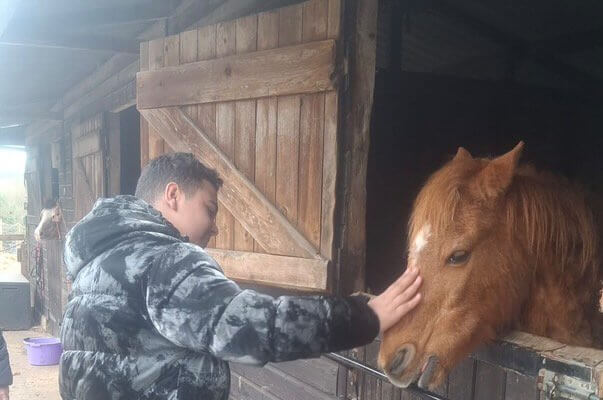
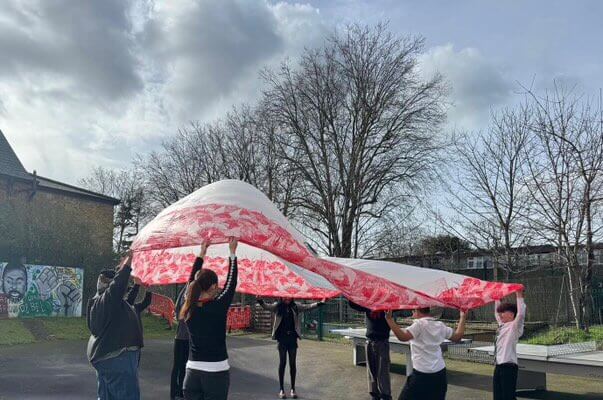
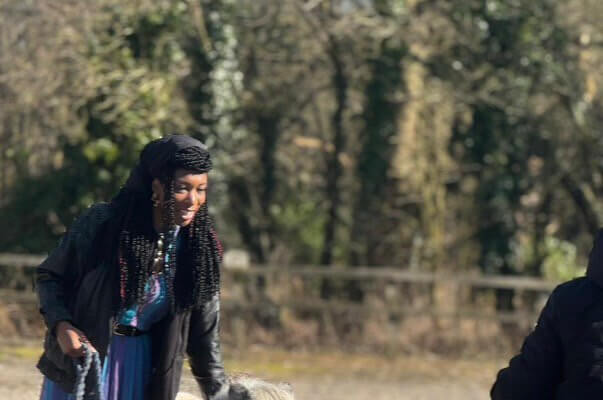
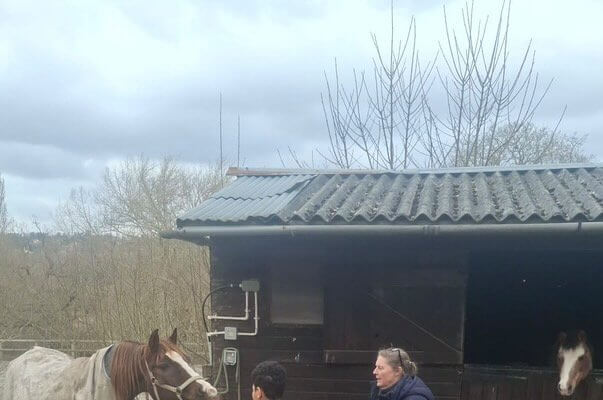
To date, we’ve been lucky to have worked with the visual artist Olivia Twist to paint a vibrant mural in a disused part of the school, music producer and sound artist Melo Zed to create immersive soundscapes and we are currently working with the artist and musician Jacob V Joyce – who is also doing PHD research exploring education and school exclusions – to build a live video game sets to explore emotions and communication. A huge part of the work is also about tuning into the complex needs of the students, so we have also been taking our cohorts to the London Equine Therapy Centre, where the brilliant director, Sarah Long, offers integrated therapy sessions with horses and ponies for people with complex trauma, those whose are neurodivergent or just want to reconnect with themselves. These sessions help with processing experiences, confidence, leadership skills, emotional regulation, somatic awareness and communication.
We know that there are still huge inequalities in arts careers and accessing the arts, and we aim to offer the students the space to connect with successful black artists who not only share their experiences but collaborate with the young people. It’s important when working on a project like this to be grounded in the realities that our brilliant students are living with – in our borough there is a 300% increased use of food banks, increased homelessness and historic disproportionate policing and unemployment. All of these factors can have a profound impact on young people’s developmental journeys. In education, we know that black and ethnic minority students are most likely to be excluded from school, and less likely to receive the support they need for behavioural and neurodevelopmental conditions. Students who are excluded – if they are not already – can end up on a school to prison pipeline.
Against this context, I’ve been thinking a lot about the writing of Ruth Wilson Gilmore who encourages us to think about what life affirming practices we can around issues like this, or Mariame Kaba, who asks us to think about the small experiments we can all try to push for change. It’s brilliant to be working with Haringey Learning Partnership who think critically about alternative provision and the many kinds of care they can make available for their students.
Bernie Grant was a big advocate of both education and disability justice, and this project is a positive unfolding of his legacy. In putting together the programme I’ve been inspired not only by Bernie Grant, but different generations of education activists: Gus John (who celebrated his 80th birthday last week), the Black Parents Movement and No More Exclusions in particular, who have crafted a deep analysis of the ways the education system can be harmful for students and impact life outcomes. I’ve also been inspired by artists such as John La Rose, a local peer of Bernie Grant, who talked about ‘social creativity’: the idea that our imaginative capacity for art making could also be directed to politically remaking the world around us through our creative energy. The practices of renowned artists Sonia Boyce and Simone Leigh have helped me think about how the process of art making itself can be a site for collective healing, alongside health and social care whilst offering interventions to address multiple legacies of colonialism and structural inequalities. I’ve also been inspired by the Black Quantum Futurist artists collective who use art to shift the outcomes of geographic inequalities through artistic and legal activations. There are countless artists around the world whose stories include making vital contributions to their local communities – blending healthcare with art making – including Noah Davis and Karon Davis (whose work is currently being exhibited at the Barbican).
Over the next year we plan to collaborate with mental health practitioners, education activists and artists to deepen our practice and create a resource that can be circulated with educators, artists and mental health providers. We hope to offer young people more opportunities to develop skills and make work. We would also like to work more closely with local mental health providers to understand how to improve access to support for students.